
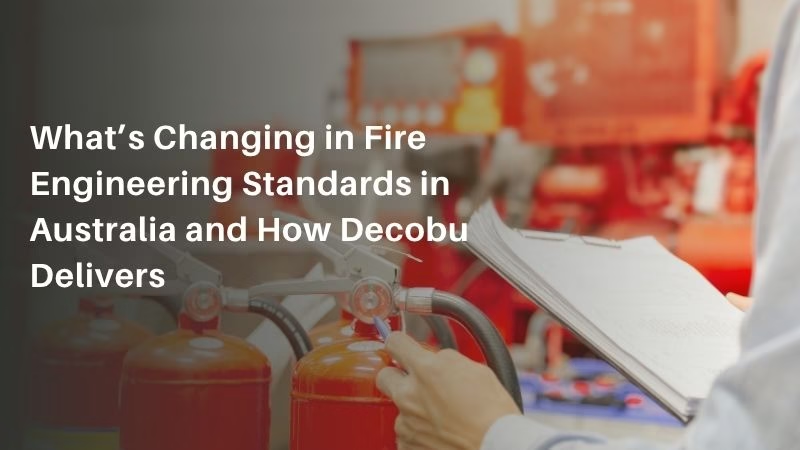
What’s Changing in Fire Engineering Standards in Australia and How Decobu Delivers

What’s Changing in Fire Engineering Standards in Australia and How Decobu Delivers

Fire Engineering Services Perth

Australia’s 2025 fire safety standards mark a major shift in how buildings are designed, assessed, and approved. These updates raise the bar for compliance, requiring smarter integration of fire engineering solutions.

In this blog, we break down the key updates, their impact on different project types, and practical strategies to achieve compliance without compromising timelines or budgets.

Understanding the 2025 Fire Safety Standards

The updated regulations increase fire resistance levels, place greater emphasis on realistic evacuation modelling, and demand stronger coordination between building services. These requirements are particularly important for complex builds such as mixed-use precincts, high-rises, industrial facilities, and heritage properties.

The changes are designed to protect lives and property more effectively by improving evacuation outcomes, strengthening passive fire protection, and ensuring systems perform reliably under real-world conditions. However, without early integration into design workflows, they can also lead to budget pressures and delays — making proactive planning essential.

Why Early Fire Engineering Matters

Engaging fire engineers early is no longer optional under the 2025 standards. It provides:

  • Reduced retrofit risks – Mitigates expensive changes during later construction phases.
  • Improved design flexibility – Allows creative solutions that align safety with project vision.
  • Optimised construction sequencing – Prevents delays by integrating fire measures with structural and building services from the start.
  • Sustainability alignment – Minimises waste and material overuse in fire separations, supporting environmental targets.

Impact of the 2025 Fire Safety Standards

The latest updates are not just technical — they influence how projects are designed, approved, and delivered:

  • Smarter integration – Fire safety now ties more closely with HVAC, Electric, and hydraulic engineering services, demanding stronger cross-discipline collaboration.

  • Earlier modelling requirements – Evacuation and smoke modelling are expected earlier in the design stage to avoid approval delays.

  • Stricter retrofit triggers – Older buildings undergoing significant refurbishment may be required to meet the new standards, increasing the need for strategic planning.

  • Client-side benefits – When addressed proactively, the new rules can lead to more efficient space use, fewer design clashes, and streamlined approvals.

Decobu’s Approach: Compliance Without Overdesign

fire safety engineering Melbourne

Our methodology focuses on foresight, collaboration, and efficiency:

  • Beyond minimum compliance – We ensure every design meets the National Construction Code (NCC) and state-specific amendments, while avoiding unnecessary overdesign.
  • Realistic evacuation modelling – We use advanced tools to analyse occupant movement, alarm response times, and exit flow rates, optimising safety without disrupting building function.
  • Integrated systems design – Both active (sprinklers, detectors, suppression) and passive (compartmentation, fire-rated glazing, intumescent coatings) measures are developed in coordination with our MEPF services to ensure compatibility.
  • Early engagement – Involving our team from the earliest design stages supports regulatory approvals, avoids rework, and allows fire strategies to enhance — not hinder — architectural intent.

Decobu has successfully applied early fire engineering strategies across commercial redevelopments, mixed-use developments, and specialised facilities. This approach has delivered efficient, compliant, and cost-effective results — shaping some of our most successful recent projects.

FAQs

1. Do the 2025 fire engineering standards increase project costs?

Not necessarily. Costs tend to rise only when compliance is left to the last minute. Involving fire engineers early allows you to plan around the new standards, avoid redesigns, and keep budgets and timelines under control.

2. What’s different in evacuation planning under the new rules?

The latest standards emphasise more realistic modelling of how people actually behave in emergencies. This includes better integration with alarm and communication systems, plus faster and more accurate fire detection technologies.

3. How does Decobu ensure fire systems work with other building services?

We coordinate closely with our mechanical engineering, electrical engineering, and hydraulic engineering teams from day one, so every system works together seamlessly — improving safety, efficiency, and compliance.

4. What are the risks if the building doesn’t meet the new standards?

Non-compliance can lead to penalties, restricted use of your building, or costly retrofits. By engaging fire engineers early, you can identify practical solutions before enforcement kicks in — saving time, money, and disruption.

Conclusion

Australia’s 2025 fire safety standards set a higher benchmark for performance, compliance, and coordination in building design. Decobu’s early, integrated approach ensures projects meet these requirements without unnecessary overdesign — delivering safer, smarter spaces that are ready for today’s needs and tomorrow’s challenges.

Ready to make your building safer and future-ready? Contact Decobu fire engineering team to design smarter, regulation-ready solutions for your next project.

Found Interesting? Share the insights

Facebook
X
LinkedIn
WhatsApp
Reddit

Related Posts