
How Are Mechanical Engineering Services Evolving to Meet Australia’s Building Standards in 2025 ?

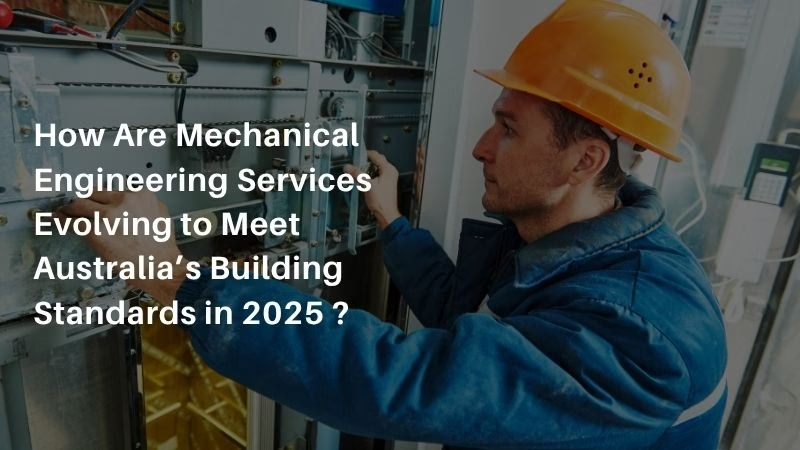
How Are Mechanical Engineering Services Evolving to Meet Australia’s Building Standards in 2025 ?

Mechanical Engineering Services

As buildings grow more complex and performance-focused, the role of mechanical engineering is shifting from system designing to strategic collaborations. The 2025 building landscape demands more than basic HVAC—it requires mechanical systems that enhance comfort, reduce emissions, and support compliance from the ground up.

At Decobu, we’re seeing how early design decisions made by mechanical consultants can shape not just a building’s compliance, but its long-term usability, energy footprint, and operational cost.

A New Era of Integration in Mechanical Services

In 2025, mechanical engineers are no longer working in isolation. Their designs are being coordinated from the earliest stages with electrical engineering, hydraulic engineering, and fire engineering services to avoid costly service clashes and delays later in the project.

Across sectors, Decobu’s projects demonstrate how early-stage mechanical input can minimise redesign risks and improve coordination and enhance system efficiency —especially on multi-storey, education, or healthcare buildings—has helped unlock more efficient plant locations, reduce spatial conflicts, and simplify compliance pathways. Coordinated planning isn’t just helpful—it’s essential

Designing Beyond the Temperature Dial

The scope of mechanical design now goes far beyond thermal control:

  • Zoned systems that optimise energy by only conditioning spaces when needed
  • Smart controls that respond to real-time usage patterns
  • Acoustic management that ensures quiet indoor environments
  • Maintenance-aware layouts that reduce service interruptions

Clients today expect buildings to perform—to be energy-efficient, quiet, healthy, and adaptable. We see this shift across retail, mixed-use, and workplace environments where user comfort is now a key success metric.

Electrical Engineering Services Perth

Electrification Is Changing the Game

As Australian cities phase out gas infrastructure, mechanical systems are being redesigned to suit fully electric buildings. This shift isn’t just about compliance—it’s about future readiness.

Mechanical and electrical teams often collaborate to:

  • Replace gas boilers with heat pumps
  • Integrate systems with rooftop solar
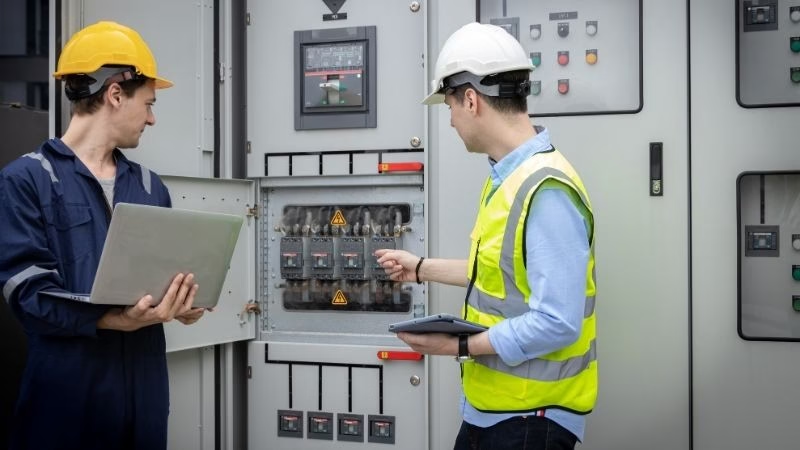
  • Design switchboards with future plant upgrades in mind

Electrification isn’t a standalone decision. It affects every system around it, Which is why our integrated approach makes a meaningful difference in cost planning in engineering projects and enhances overall operational efficiency.

Comfort and Safety Now Go Hand in Hand

Post-COVID, mechanical systems are playing a larger role in safety—especially when it comes to air quality. Designers are now expected to:

  • Increase fresh air rates
  • Deliver effective smoke exhaust and stairwell pressurisation systems
  • Ensure correct filtration levels
  • Add demand-controlled ventilation for air quality based on occupancy

This has been especially important in projects involving essential services or high-occupancy environments. Our team has designed mechanical systems to meet all applicable codes while delivering efficient, compliant HVAC solutions tailored to sector needs such as healthcare, aged care, commercial and industrial buildings.

What Do Clients Now Expect from Mechanical Consultants?

In 2025, clients expect mechanical engineers to:

  • Provide insights from concept stage, not just during services documentation


  • Balance compliance with long-term performance goals


  • Offer design flexibility without sacrificing construction clarity


  • Work fluidly across multiple disciplines


At Decobu, we’re often involved from day one—reviewing massing studies, supporting early-stage thermal modelling, and identifying risks before they reach the site. This early, strategic involvement adds value far beyond the traditional scope of work.

FAQs

What are mechanical engineering services in buildings?

They involve the design of heating, ventilation, cooling, air quality, smoke control, and related systems that ensure occupant comfort, building safety, and energy performance.

How is NCC 2025 impacting mechanical design?

National Construction Code (NCC) 2025 introduces new rules around ventilation, air tightness, thermal zoning, and system efficiency. Mechanical consultants now play a larger role in helping projects meet compliance.

How is electrification changing mechanical systems?

Mechanical designs are moving away from gas toward all-electric solutions, often integrated with renewables. This affects HVAC equipment selection, plant sizing, and energy planning.

Are mechanical services consistent across Australia?

Not exactly. Climate zones, local council requirements, and energy priorities vary. A mechanical strategy that works in Melbourne might not suit a project in Brisbane or Perth without adjustments.

Final Thoughts

Mechanical engineering services in 2025 are about more than compliance. They’re about performance, resilience, and getting things right before construction begins. At Decobu, we understand that mechanical systems don’t just control temperature—they influence how buildings function, how they feel, and how they age.

By aligning design intent with practicality, we help deliver buildings that are ready for what’s next.

Looking to future-proof your next project? Talk to Decobu about smarter mechanical engineering solutions.

Found Interesting? Share the insights

Facebook
X
LinkedIn
WhatsApp
Reddit

Related Posts