
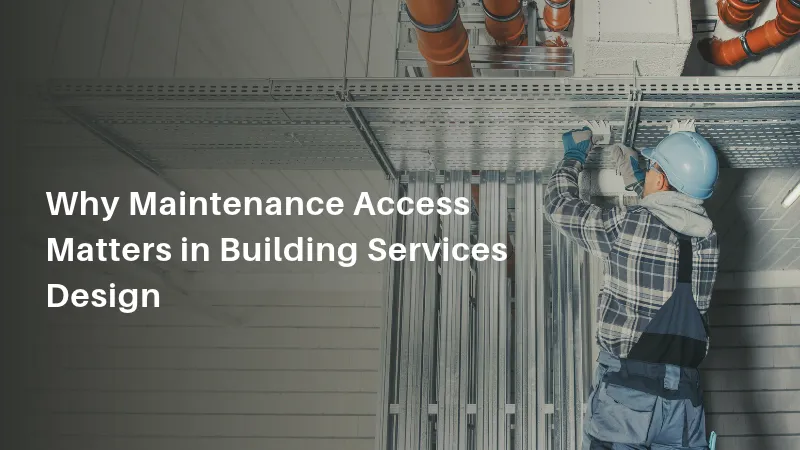
Building services need to do more than work when a building is completed. They also need to remain accessible for inspection, maintenance, repair and eventual replacement.
Equipment may be correctly specified and installed, but if there is not enough space to reach it safely or remove it when required, the design can create problems later.
Maintenance access is therefore not simply an operational consideration. It is something that needs to be considered as part of the building services design.
Why Can Maintenance Access Be Overlooked?
During Building Services Design construction, the focus is often on fitting equipment and services within the available building space.
Plant rooms, ceiling spaces, risers and service areas can have several competing requirements. Equipment needs to fit, services need to be routed and the architectural layout needs to work.
The space left for maintenance can therefore become an afterthought.
A system may work as intended but still be difficult to inspect, service or replace because access was not properly considered during the design.
Where Can Access Become a Problem?
Plant Rooms
Plant rooms need more than enough space for equipment to physically fit.
Technicians may need room to inspect equipment, access components, carry out servicing and eventually remove or replace equipment.
If equipment is positioned too close together or access routes are restricted, routine maintenance can become more difficult.
Ceiling Spaces
Ceiling voids can contain ducts, pipes, cable trays, fire services and other building infrastructure.
Equipment, valves, controls and other components may need to remain accessible even when they are located above a finished ceiling.
If access is not considered, maintenance may require additional work to reach the relevant component.
Service Risers
Risers provide important routes for vertical building services, but they can also become difficult areas to access.
The arrangement needs to allow relevant services to be inspected and maintained without creating unnecessary difficulties for future work.
Equipment Replacement
Maintenance access is not only about servicing existing equipment.
Eventually, equipment may need to be repaired, upgraded or replaced. The route needed to remove the existing equipment and bring in the replacement should be considered as part of the overall arrangement.
A piece of equipment that can be installed easily may not necessarily be easy to replace later.
What Problems Can Poor Access Create?
Difficult access can affect more than the maintenance team.
Longer Maintenance Work
If technicians cannot easily reach equipment or components, routine work may take longer than necessary.
Greater Disruption
Maintenance may require additional access, temporary removal of building elements or disruption to occupied areas.
This can be particularly important in commercial buildings where building operations need to continue while work is carried out.
More Difficult Repairs
Components that are difficult to reach can make troubleshooting and repair more complicated.
Replacement Challenges
When equipment reaches the end of its useful life, poor access can make removal and replacement more difficult and potentially affect how future upgrades are carried out.
These problems may not be obvious when the building is first completed, which is why access needs to be considered earlier.
Maintenance Access Is More Than a Door or Walkway
Providing an access panel does not automatically mean that a service is easy to maintain.
The person carrying out the work may also need enough space to reach the equipment, remove components, use tools and safely complete the required task.
The arrangement around the equipment matters as much as the access point itself.
For larger equipment, there may also need to be a practical route for removal and replacement.
This means serviceability needs to be considered in relation to the equipment, surrounding services and available building space, rather than as an isolated access requirement.
Why Multidisciplinary Coordination Matters
Maintenance access can be affected by several parts of a Building Services Design.
Mechanical equipment may need electrical connections. Hydraulic services may run through the same areas as electrical or mechanical systems. Fire services and architectural elements also need to be coordinated within the available space.
A change to one system can therefore reduce the access available to another.
Considering these relationships during Building Services Design helps the project team identify potential conflicts before they become construction or operational problems.
Designing for the Building’s Future
A building’s requirements do not stop when construction is complete.
Equipment will need servicing. Components may need to be replaced. Building layouts may change, and systems may eventually need to be upgraded.
Designing with these future requirements in mind can make the building easier to operate and maintain over its lifespan.
This is particularly relevant to commercial buildings and projects where access to plant and services needs to be managed alongside normal building operations.
How Decobu Approaches Serviceability
Decobu considers Building Services Design as part of the wider project rather than as isolated systems.
Mechanical, electrical, hydraulic and fire services need to work within the available building space while also allowing for practical operation, maintenance and future requirements.
Considering access during the Building Services Design process can help identify potential constraints around plant rooms, service routes, equipment locations and other areas where maintenance may eventually be required.
The aim is to develop building services that are not only functional when installed, but practical to manage throughout the building’s life.
Final Thought
Design for the Life of the Building
A Building Services Design can be technically sound and still create problems if the people responsible for maintaining it cannot reach it properly.
Considering maintenance and replacement access during design can help reduce unnecessary disruption and make future servicing more practical.
Good building services design should consider not only how a system will be installed, but how it will be accessed, maintained and replaced years later.
Frequently Asked Questions
Why is maintenance access important in building services design?
Maintenance access allows equipment, components and services to be inspected, serviced, repaired and eventually replaced without unnecessary difficulty or disruption.
What areas commonly need maintenance access?
Plant rooms, ceiling spaces, service risers, equipment locations, valves, controls and other service components may require regular or occasional access.
Can poor maintenance access increase building costs?
It can make servicing, repairs and equipment replacement more difficult and time-consuming, potentially increasing disruption and the resources required to carry out future work.
Should equipment replacement access be considered during Building Services Design?
Yes. Equipment may eventually need to be removed or replaced, so the available space and practical route for future replacement should be considered alongside installation and maintenance requirements.
Does maintenance access affect multidisciplinary coordination?
Yes. Mechanical, electrical, hydraulic, fire and architectural elements often share the same spaces. The arrangement of one system can therefore affect access to another.